
 Premium Block Paving Systems · Specialist Division
BLOCK by Hinchliffe
Tobermore Approved block paving with sub-bases that outlast the blocks. Block driveways, courtyards, premium paving, borders and decorative features.
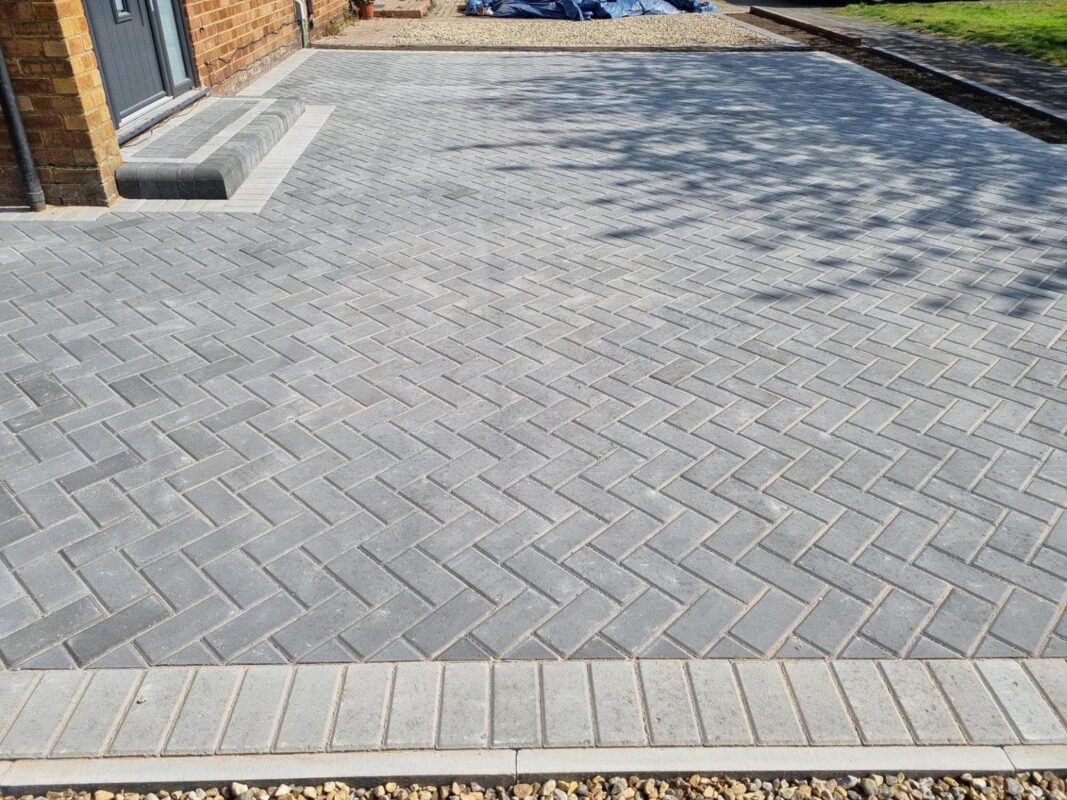
Every block by hinchliffe install is engineered using recognised pavement-construction principles and relevant BS 7533 guidance, survey, engineered sub-base, edge restraints and approved surface systems.
Traditional and contemporary block paving in a wide range of formats, colours and laying patterns. As Tobermore Approved Paving Contractors we install to the manufacturer's spec, meaning the sub-base, edge restraint and jointing all match the surface guarantee.
Best for
- →Character properties and traditional homes
- →Driveways that need defined patterns or borders
- →Patios integrated with driveway design
Engineered block pavement systems
A block pavement is a structural construction, not a pattern choice. The laying course, restraint and jointing are specified alongside the sub-base rather than decided on site.
Construction sequence
Adjusted to loading, ground conditions and the specified pavement.
- 1Excavation to formation
- 2Formation preparation
- 3Geotextile separation where specified
- 4Structural sub-base compacted in layers
- 5Laying course to the specified material and depth
- 6Edge restraint
- 7Block pavement laid to the specified bond
- 8Jointing
- 9Compaction
- 10Drainage, falls and discharge completed as designed
Relevant BS 7533 principles are applied to modular pavement construction, alongside manufacturer specifications and project-specific requirements.
A block pavement is a structure made of many small pieces
Block paving is often presented as a finish, a choice of colour, format and pattern. Structurally it is something more interesting: an interlocking modular pavement that distributes load through the interaction of the blocks, the jointing material between them, the bedding layer beneath them and the sub-base below that.
That interlock is what carries the vehicle. It only exists if the blocks are laid to consistent dimensions and joint widths, if the joints are filled and compacted, if the bedding layer is uniform, if the sub-base is properly constructed, and above all if the whole field is restrained at every edge. Remove any one of those and the pavement stops behaving as a structure and starts behaving as loose units.
This is why most block driveways that have gone wrong have not failed at the block. They have failed at the edge, in the bedding, in the sub-base, or because water was allowed to sit where it should not.
Assessment and set-out
- →Existing construction, its depth and whether any of it can be retained.
- →Formation condition, bearing capacity, made ground and roots.
- →Water behaviour, existing falls and where discharge is available.
- →Threshold, door, garage and airbrick levels that fix the finished surface level.
- →Boundaries, walls, planting and adjacent hard surfaces that the pavement must tie into.
- →Intended loading, including trailers, vans and occasional heavier vehicles.
- →Laying pattern selected for the application: herringbone develops the strongest interlock under vehicle loading, stretcher and stack patterns behave differently.
- →Set-out lines established from the most visible reference, usually the house frontage or the entrance, so lines read straight to the eye.
- →Falls designed and set out before laying, not created by adjusting bedding depth.
- →Cutting planned so cuts fall where they are least visible and never so small that a unit cannot be restrained.
- →Course lines and joint widths controlled continuously as laying proceeds.
Construction sequence
Materials, layer types and depths are specified per project from the assessment and the intended loading.
- →Excavation to a formation capable of supporting the pavement under its intended loading.
- →Formation inspected and treated where soft spots, made ground or water are found.
- →Separation geotextile specified where subgrade fines would migrate into the sub-base.
- →Granular sub-base placed and compacted in controlled layers to the designed level and falls.
- →Depth and material determined by formation, loading and whether the design is permeable or impermeable.
- →Permeable construction uses open-graded material so water can pass through the pavement rather than run off; that requires the whole construction to be designed for it, not just the jointing.
- →Restraint installed to every free edge before the field is laid: kerb, edging or block-on-edge with concrete haunching.
- →Restraint is the single most important detail in a block pavement. Without it the field spreads under load, joints open and interlock is progressively lost.
- →Restraints set to line and level so they define the pavement geometry rather than being fitted around it.
- →Bedding layer screeded to a consistent thickness. Consistency matters more than depth; variable bedding produces differential settlement that shows as an uneven surface within the first year.
- →Blocks laid to the set-out, working off laid material to avoid disturbing screeded bedding.
- →Cutting by saw to clean lines, with cut units fully supported and restrained.
- →Joints filled with the specified jointing material and worked in fully, because the joint is a structural component and not a cosmetic infill.
- →Compaction by plate over the laid field to bed the units and consolidate the joints, followed by further jointing and re-compaction as required.
- →Utility covers and chambers adjusted to finished level, with recessed covers used where an unbroken surface is required.
- →Channels, gullies and threshold drainage integrated into the set-out.
- →Thresholds detailed to maintain the required height below damp-proof course and away from airbricks.
- →Interfaces with tarmac, resin, paths, patios and the adopted highway detailed and restrained.
Depths, materials and jointing specification are confirmed in the written specification after assessment.
What actually determines long-term performance
Contains the field so interlock is maintained under load.
- →Continuous restraint to every free edge, properly haunched.
- →Cut units at edges sized so they can be held rather than working loose.
- →Restraint checked at thresholds, entrances and turning areas where lateral force is highest.
Controls settlement and surface regularity.
- →Uniform screeded thickness across the whole area.
- →No local packing of bedding to correct level errors that belong in the sub-base.
- →Compaction carried out across the full field, not just in trafficked areas.
Carries and spreads the load.
- →Placed in controlled layers with compaction at each layer.
- →Constructed to the design falls so water is not held at the base of the pavement.
- →Extended beyond the pavement edge where the restraint requires support.
The practical benefit of modular construction.
- →Units can be lifted and relaid, so a service trench, a settled area or a damaged section can be reinstated without resurfacing the whole pavement.
- →Spare units retained at handover allow a like-for-like repair years later.
- →Well-executed reinstatement is largely invisible, which is not the case with monolithic surfaces.
Maintenance
Block pavements need their joints kept full, their drainage kept clear and organic growth kept under control. Joint loss is the mechanism behind most gradual deterioration: once joints empty, interlock reduces, units start to move and the rate of decline accelerates.
Periodic cleaning, joint refurbishment and, where appropriate, sealing keep the pavement performing. Localised settlement can usually be corrected by lifting, correcting the bedding and relaying, which is one of the real advantages of modular construction over a monolithic surface.
Controls we apply
Block paving is unforgiving of shortcuts and very durable when built properly.
Edge restraints installed and haunched before the main laying begins.
Falls designed and set out, with regular checks through laying rather than at the end.
Joints filled and consolidated, with re-jointing after compaction as required.
As a Tobermore Approved Paving Contractor we install in line with manufacturer requirements. That supports the specification; the competence and the workmanship are ours.
5-Year Workmanship Guarantee on our installation; product warranties are issued separately by the manufacturer under their own terms.
Where the money goes
The block is a modest proportion of the cost of a block pavement.
Depth, arisings, haulage and formation treatment.
Material, depth and layered compaction sized for the loading.
Edgings, kerbs, haunching and the detailing that holds the pavement together.
Channels, gullies, threshold detailing and cover adjustment.
Set-out, cutting, dimensional control, jointing and compaction, the largest single labour element.
Written specification, handover records, spare units and maintenance guidance.
We assess the existing construction, ground conditions, levels, drainage, access and intended loading before recommending the correct surface system.
Related reading
How every Hinchliffe pavement is assessed, specified and constructed.
Excavation, formation, levels, drainage and restraint.
Planned inspection, cleaning and maintenance.
Approved systems, insurance, competency and guarantees.
The questions worth asking of any quotation, including ours.
Site footage and photography from live Hinchliffe projects.
Free, no obligation, and the basis of every written specification.
Ground conditions and local detail across Cheshire.
BLOCK by Hinchliffe, your questions.
Is block paving built to a recognised standard?
BS 7533 provides recognised guidance for the design and construction of modular pavements using clay, concrete and natural stone paving units. Hinchliffe applies relevant BS 7533 principles where appropriate, alongside established pavement-engineering practice, manufacturer specifications and project-specific requirements.
How long does block paving last?
A correctly designed, installed and maintained block pavement can provide decades of service. Most 'failed' driveways aren't failed blocks, they're failed edges or an under-specified sub-base. As Tobermore Approved Paving Contractors we build to manufacturer spec so the guarantee stands.
Will weeds grow between the blocks?
Not if the joints are done properly. We use kiln-dried sand or polymeric jointing to fully lock the joints. Weeds usually only appear when jointing sand has washed out, top up sand periodically and you'll rarely see any.
What's the difference between kiln-dried and polymeric jointing?
Kiln-dried sand is the traditional option, cheap, easy to top up, but can wash out over time. Polymeric jointing sets hard after wetting, resists weeds and washout, and works well on slopes or driveways washed frequently. We recommend the right one per project.
Do I need planning permission for a block paving driveway?
Permeable construction can often avoid the need for planning permission for front-garden driveways, provided the complete system manages water within the property and satisfies applicable planning and drainage requirements. Final suitability depends on the complete construction, subgrade permeability, levels, discharge route and local site conditions, not the surface material alone. We design drainage in as standard, using permeable blocks or channelling to a soakaway where appropriate.
Can you replace or repair sunken blocks?
Yes. Individual blocks can be lifted, the base re-levelled and the block re-laid. If a whole area is sinking, it's a sub-base failure, not a block failure, that needs excavation and re-laying to fix properly.
Why do block paving driveways sink or spread?
Almost always because of the construction rather than the blocks. The usual mechanisms are inadequate or missing edge restraint allowing the field to spread, variable bedding thickness causing differential settlement, a sub-base that is too thin or poorly compacted for the loading, or water held in the construction because falls and drainage were not designed.
Is permeable block paving different to standard block paving?
Yes, structurally. Permeable block paving uses open-graded jointing and a permeable granular construction so water passes down through the joints and through the pavement. It is a whole-construction design, not a change of surface product. Whether it satisfies drainage or planning requirements depends on the complete design, the subgrade's ability to accept infiltration and the discharge strategy.
What laying pattern is strongest?
Herringbone develops the most effective interlock under vehicle loading because no continuous joint line runs in the direction of travel. Stretcher, basketweave and stack patterns are legitimate choices where loading is lighter or where appearance leads, and we will tell you where a pattern choice has a structural implication.
Can a damaged area be repaired without redoing the whole driveway?
Yes, and this is one of the genuine advantages of modular construction. Units can be lifted, the bedding or sub-base corrected and the same units relaid. We retain spare units at handover so a later repair matches.
Does the Tobermore approval mean the driveway is guaranteed by Tobermore?
The two are separate. Our approved contractor status means we install in line with the manufacturer's requirements, and Tobermore issue their own product warranties under their own terms. Our 5-Year Workmanship Guarantee covers our installation. We describe them separately because they cover different things.
Block paving
- Excavation
- Disposal of arisings
- Formation assessment
- Geotextile where specified
- Engineered Type 1 sub-base
- Drainage provisions
- Structural edge restraints
- Compliant laying course
- Selected Tobermore paving
- Cutting, jointing and final compaction
- Completion inspection
- Selected product and laying pattern
- Cutting complexity and level changes
- Excavation depth and disposal
Uplift depends on the selected product and laying design.
Permeable paving requires a complete compatible system. Permeable blocks laid over a conventional impermeable construction must not be described as a permeable driveway.
Recommended minimum block-paving project value: £5,000 plus VAT
The rates above cover the surfacing system itself. Everything below the surface, and everything site-specific, is measured and calculated separately in the Hinchliffe Project Builder™ process.
- Excavation, formation preparation and compaction
- Spoil removal, haulage and tip disposal
- Sub-base supply, laying and testing
- Drainage, soakaways, linear channels and SUDS provision
- Kerbs, edgings, retaining structures and level changes
- Service covers, utility alterations and manhole adjustment
- Restricted access, plant hire and site complexity allowances
- Mobilisation, welfare, traffic management and risk allowances
Guide prices are not quotations or contractual offers. Final pricing is issued only after site assessment, measured quantities and confirmation of the construction specification. Prices exclude VAT unless expressly stated otherwise. Unforeseen ground conditions, concealed services, contamination and client-requested changes are managed under the written contract and variation procedure.
Request a measured site assessmentBlock Paving by town
Ground conditions change from one Cheshire town to the next. Pick your area to see how we build there, what we typically find below the surface and what it usually costs.
Customer proof
"Dan came out to provide a quote for a driveway replacement including an extension to the existing driveway. We found Dan to be highly professional, very informative and the detailed quote enabled us to understand the cost breakdown precisely. It was easy to discuss options and benefits of each with Dan and his product knowledge was superb. From first point of contact we were highly impressed."
"We were really impressed with the project management, the team kept the neighbours informed throughout the job and everything ran smoothly from start to finish. A five-star service."
"Dan and the team were professional from start to finish. The workmanship was outstanding and the driveway has completely transformed our home. Highly recommend."