
 Engineered Asphalt & Tarmac Systems · Specialist Division
TARMAC by Hinchliffe
Machine-laid tarmac done to a proper commercial standard. Domestic driveways, private roads, farm roads, estate roads and car parks.
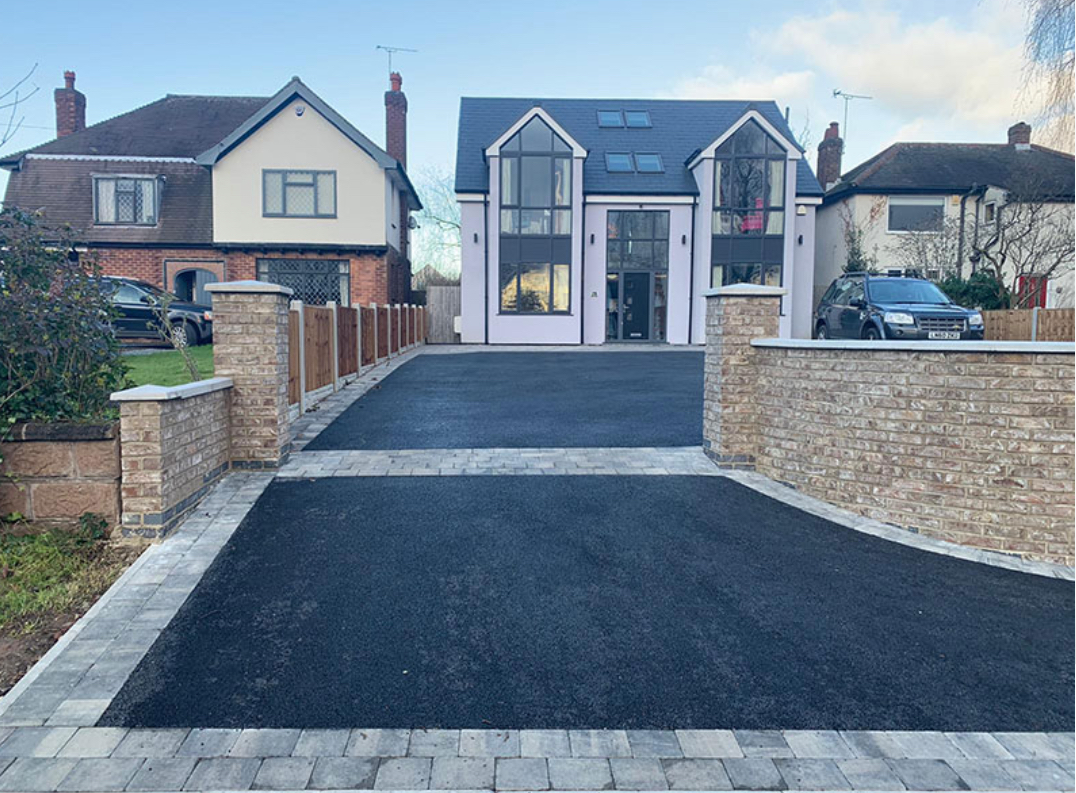
Every tarmac by hinchliffe install is engineered using recognised pavement-construction principles and relevant BS 7533 guidance, survey, engineered sub-base, edge restraints and approved surface systems.
Traditional black-top surfacing for driveways, private lanes, farm yards and commercial hardstandings. We lay tarmac hot, roll it properly and cut sharp edges, no cold joints, no soft edges, no shortcuts.
Best for
- →Long driveways and shared accesses
- →Commercial hardstandings and yards
- →Cost-effective large-area surfacing
Engineered asphalt & tarmac surfacing
Asphalt is specified in two fundamentally different ways. Full reconstruction builds the pavement from the formation upward. Resurfacing works with an existing structurally sound pavement. The right route is decided at survey, not assumed.
Full reconstruction
Where the existing construction is unsuitable, failed, or does not exist.
- 1Formation, existing construction removed to the required depth
- 2Ground preparation and geotextile separation where required
- 3Structural sub-base, granular construction compacted in layers
- 4Edge restraints and kerbing
- 5Asphalt binder course
- 6Asphalt surface course
- 7Final compaction and detailing
Actual thicknesses and materials depend on loading, ground conditions and specification.
Resurfacing / overlay
Where assessment confirms the existing pavement is structurally sound and suitable to be overlaid.
- 1Assessment of the existing pavement condition and levels
- 2Localised repairs where required
- 3Preparation or planing where required
- 4Bond or tack coat as specified
- 5Regulating course where necessary to correct levels
- 6New asphalt surface course
- 7Compaction and detailing
Applications
Machine-laid residential surfacing with defined edge detail and falls set before the surface is laid.
Shared access and estate roads constructed for repeated vehicle movements and turning loads.
Bay layouts, falls, drainage interfaces and kerbing coordinated as one construction.
Yards, hardstanding and service areas specified around anticipated loading and use.
Tarmac is a structural pavement, priced like a finish
Asphalt is the most widely used pavement surfacing in the country because it is fast to lay, economic over large areas and genuinely durable when it is built correctly. It is also the surface most often supplied as a thin bound layer over whatever happens to be there, which is where its reputation for early failure comes from.
An asphalt pavement distributes wheel loads down through bound layers into a granular construction and then into the subgrade. Every one of those layers has a job. If the granular layer is thin or contaminated, or the subgrade is soft, or water sits in the construction, the bound layers are asked to do work they were never sized for, and they crack, deform or ravel at the point of highest stress.
So the useful question is not what tarmac costs per square metre. It is what the pavement is being asked to carry, what it is being built on, and where the water goes.
Assessment and design inputs
These are the inputs that determine the specification. None of them can be established from a photograph.
- →Residential driveway: cars, occasional van or trailer.
- →Shared or private access road: repeated vehicle movements, turning, and often service and refuse vehicles.
- →Car park: frequent light-vehicle movements with concentrated stress in bays, aisles and turning areas.
- →Yard and hardstanding: heavy point loads, plant, deliveries, containers, static loading.
- →Loading determines layer thickness, material selection and granular construction. It is the single largest driver of specification.
- →What exists, how thick it is, whether it is bound, and whether it is stable under load.
- →Whether the correct approach is overlay of retained construction, partial reconstruction, or full excavation to formation.
- →Formation condition once opened: bearing capacity, made ground, soft spots, roots and water.
- →Capping specified where the formation cannot support the granular layer directly.
- →Geotextile separation specified where fines from the subgrade would migrate into and compromise the granular layer.
- →Designed falls to a defined discharge point, established before construction rather than chased at surfacing stage.
- →Channels, gullies, linear drainage and threshold interception where levels require them.
- →Impermeable surfaces must have a route for water. Surface water discharge is designed as part of the works.
- →Threshold, garage, airbrick and boundary levels that constrain finished level.
- →Interfaces with the adopted highway and existing dropped kerbs.
How we construct an asphalt pavement
Layer thicknesses and material types are project-specific. We publish the sequence and the reasoning, not a universal depth.
- →Excavation to formation, with arisings removed under controlled loading and haulage.
- →Formation prepared and proof-checked before anything is built on it.
- →Capping layer where the formation requires it.
- →Separation geotextile where specified.
- →Granular sub-base placed and compacted in controlled layers to the designed level and falls.
- →Edge restraint by kerb, edging or haunched detail, so the bound layers are supported at the perimeter where they are most vulnerable.
- →Kerbing and channels set to line and level before surfacing.
- →Gullies, linear drainage and connections installed and tested to the designed falls.
- →Utility covers and chambers adjusted to finished level.
- →Binder or base course providing the structural bound layer, thickness selected against loading and construction depth.
- →Surface course selected for the application: aggregate size, texture, appearance and durability differ between a domestic driveway and a trafficked yard.
- →Tack coat applied between layers where specified so the pavement behaves as a bound structure rather than as separate sheets.
- →Materials ordered against the specification and delivered at the correct temperature for laying.
- →Machine laying by paver wherever access allows, giving consistent thickness, level and texture and a controlled temperature at compaction.
- →Hand laying used where access, geometry, detail or tie-in makes machine laying impractical, and worked and compacted before temperature loss.
- →Rolling to achieve compaction while the material is within its working temperature window.
- →Joints planned and formed rather than allowed to occur wherever the day ends; longitudinal and transverse joints are the most common source of early defects.
- →Tie-ins to existing surfaces, kerb lines, thresholds and covers cut, sealed and detailed.
Layer types and depths are confirmed in the written specification issued after assessment.
Applications and what changes between them
- →Appearance, edge detail, threshold levels and interface with paths and planting matter as much as structure.
- →Access frequently restricts plant size, which affects method and programme.
- →Falls must move water away from the property rather than towards it.
- →Repeated movements, turning stresses and service-vehicle loading push specification well beyond a domestic build-up.
- →Drainage runs are longer, so falls and discharge capacity need designing rather than assuming.
- →Phasing matters because access has to be maintained for residents.
- →Concentrated stress in aisles, turning areas and at bay entries.
- →Static and point loading in yards and storage areas influences both granular construction and bound layer selection.
- →Line marking, delineation and interface with buildings, doors and loading areas are set out as part of the works.
Maintenance and life extension
Asphalt rewards attention early and punishes neglect. Keeping drainage points clear, dealing with fuel and oil spillage, sealing joints and treating localised defects before water gets into the construction all extend service life materially.
Where a pavement is structurally sound but the surface course is worn, a planned overlay is usually the economic answer. Where water has been in the construction and the granular layer or formation has been compromised, reconstruction of the affected area is the honest answer. We inspect and tell you which one applies rather than defaulting to the larger job.
Overlay, partial reconstruction or full reconstruction
Three legitimate approaches. The right one is chosen from condition, not from the size of the invoice.
Retained construction prepared, levels and covers dealt with, and a new surface course laid over it.
- →The existing pavement is structurally sound with no active deformation
- →Cracking is limited and not evidence of movement below
- →Drainage works and water is not sitting in the construction
- →Levels and thresholds can accept the additional thickness
- →Edges are restrained or will be restrained as part of the works
Determined by: Determined by the condition of the existing construction and the behaviour of water on and within it.
Localised areas taken out and rebuilt, with the remainder retained and overlaid.
- →Failure is confined to identifiable areas such as turning points, entrances or a wet corner
- →The remainder of the pavement is performing
- →A drainage defect can be corrected within the affected area
Determined by: Determined by whether the defect is local or a symptom of a pavement-wide problem.
Excavation to formation and rebuilding the complete pavement, including drainage and restraint.
- →Deformation, rutting or widespread cracking indicates the construction is inadequate for the loading
- →The granular layer or formation is contaminated or saturated
- →Loading is increasing beyond what the existing pavement was built for
- →Levels must be lowered rather than raised
Determined by: Determined by formation condition, loading and drainage, confirmed by assessment and where necessary by opening up.
Controls that protect the pavement
The defects that shorten asphalt life are largely preventable at construction stage.
Falls and discharge designed before surfacing, because water in the construction is the primary cause of premature failure.
Material laid and rolled within its working temperature window, in controlled layers.
Joints planned, formed and sealed rather than left to chance at the end of a working day.
Restraint detailed so perimeter loading does not break the edge down.
5-Year Workmanship Guarantee on our installation, plus scheduled inspection through Surface Care if you want the asset monitored.
Where the money goes
Two asphalt quotations can differ by a large margin and both be honest. The difference is usually below the surface.
Depth taken out, arisings loaded and hauled, and the cost of getting to a formation you can build on.
Capping, separation and sub-base sized for the loading, not for the quotation.
Gullies, channels, connections, kerbs and level control.
Binder and surface course thickness and material grade selected against traffic.
Paver, rollers and crew, and the access work needed to get them to the area.
Written specification, variation control, handover and guarantee.
We assess the existing construction, ground conditions, levels, drainage, access and intended loading before recommending the correct surface system.
Related reading
How every Hinchliffe pavement is assessed, specified and constructed.
Excavation, formation, levels, drainage and restraint.
Car parks, yards, estate roads and external works.
Planned inspection, cleaning and maintenance.
Approved systems, insurance, competency and guarantees.
The questions worth asking of any quotation, including ours.
Free, no obligation, and the basis of every written specification.
Ground conditions and local detail across Cheshire.
TARMAC by Hinchliffe, your questions.
Is tarmac built to BS 7533?
Our tarmac and asphalt construction is specified around anticipated loading, formation condition, drainage, layer thickness and appropriate asphalt materials.
How long does a tarmac driveway last?
A machine-laid tarmac driveway on a correctly constructed structural sub-base can provide many years of service before a wearing-course overlay is required, depending on loading, drainage and maintenance. Hand-tamped tarmac over a weak base rarely makes it past five winters, the build-up matters more than the surface.
What's the difference between machine-laid and hand-laid tarmac?
Machine-laid tarmac is fed hot from a paver and rolled to a uniform density, giving a tight, long-lasting surface. Hand-laid tarmac cools before it's compacted, leaving loose material and weak edges. We machine-lay wherever access allows.
Can you resurface an existing tarmac driveway?
Yes, if the base is structurally sound we can overlay it with a new wearing course, saving cost versus a full excavation. If the base is cracked, sinking or holding water, an overlay just hides the problem; we'll say so honestly and price a full rebuild instead.
How soon can I drive on new tarmac?
You can walk on it once it's cooled (a few hours). Light vehicle use is fine after 24 hours. Avoid sharp turning on the spot, jacks, and prop stands for the first 2–3 weeks while it fully hardens.
Is tarmac suitable for driveways and just for roads?
Tarmac is excellent for residential driveways, private lanes, farm accesses and commercial yards. It's the most cost-effective surface for larger areas and takes heavy loads. For smaller drives where kerb appeal matters, resin or block often suits better.
What depth should a tarmac driveway be?
There is no single correct depth. Construction depth is determined by ground conditions, the condition of the existing construction, intended loading, drainage and the application. A domestic driveway carrying cars and a yard carrying delivery vehicles are different pavements. The confirmed layer arrangement is issued in your written specification after the site assessment.
Is machine laying always better than hand laying?
Machine laying gives more consistent thickness, level, texture and compaction temperature, so we machine lay wherever access and geometry allow. Hand laying is the correct method for restricted access, tight detail, tie-ins and small or irregular areas, and it performs well when the material is worked and compacted before it loses temperature. The issue is not the method, it is whether compaction is achieved within the working window.
Can you overlay my existing tarmac instead of digging it out?
Where the existing pavement is structurally sound, drains properly and can accept the additional thickness within available threshold levels, an overlay is the economic and correct answer. Where there is deformation, water in the construction or evidence that the pavement is under-built for its loading, an overlay conceals the defect rather than correcting it, and we will say so.
How do you deal with drainage on an impermeable surface?
Falls are designed to a defined discharge point, and channels, gullies or linear drainage are installed where the levels require them. Threshold interception is used where a surface runs towards a building. The discharge strategy is established at assessment; surface water is not simply directed onto the highway or a neighbouring property.
Do you carry out repairs as well as full surfacing?
Yes, including localised reconstruction, pothole and defect repair, joint sealing, cover adjustment and drainage correction. Where a repair is not the right answer because the underlying construction has failed, we will tell you what the alternative is and what it involves.
Tarmac and asphalt
- Excavation
- Disposal of arisings
- Formation assessment
- Geotextile where specified
- Type 1 sub-base constructed in controlled layers
- Required edge restraints
- Asphalt binder course
- Asphalt surface course
- Rolling and compaction
- Completion inspection
Rate depends materially on total area, access for paving equipment, asphalt quantity, haulage, edge detailing, drainage and whether machine laying is practical.
Only available where the retained pavement is structurally suitable. Planing, regulating material, failed-edge reconstruction, ironwork adjustment and extensive local repairs are additional.
Recommended minimum tarmac project value: £5,000 plus VAT
The rates above cover the surfacing system itself. Everything below the surface, and everything site-specific, is measured and calculated separately in the Hinchliffe Project Builder™ process.
- Excavation, formation preparation and compaction
- Spoil removal, haulage and tip disposal
- Sub-base supply, laying and testing
- Drainage, soakaways, linear channels and SUDS provision
- Kerbs, edgings, retaining structures and level changes
- Service covers, utility alterations and manhole adjustment
- Restricted access, plant hire and site complexity allowances
- Mobilisation, welfare, traffic management and risk allowances
Guide prices are not quotations or contractual offers. Final pricing is issued only after site assessment, measured quantities and confirmation of the construction specification. Prices exclude VAT unless expressly stated otherwise. Unforeseen ground conditions, concealed services, contamination and client-requested changes are managed under the written contract and variation procedure.
Request a measured site assessmentTarmac Driveways by town
Ground conditions change from one Cheshire town to the next. Pick your area to see how we build there, what we typically find below the surface and what it usually costs.
Customer proof
"Dan came out to provide a quote for a driveway replacement including an extension to the existing driveway. We found Dan to be highly professional, very informative and the detailed quote enabled us to understand the cost breakdown precisely. It was easy to discuss options and benefits of each with Dan and his product knowledge was superb. From first point of contact we were highly impressed."
"We were really impressed with the project management, the team kept the neighbours informed throughout the job and everything ran smoothly from start to finish. A five-star service."
"Dan and the team were professional from start to finish. The workmanship was outstanding and the driveway has completely transformed our home. Highly recommend."