
 Engineered Resin Bound Systems · Specialist Division
RESIN by Hinchliffe
Seamless, permeable, made for British weather. Resin driveways, patios, pathways and overlays, permeable, SUDS-aligned, monolithic.
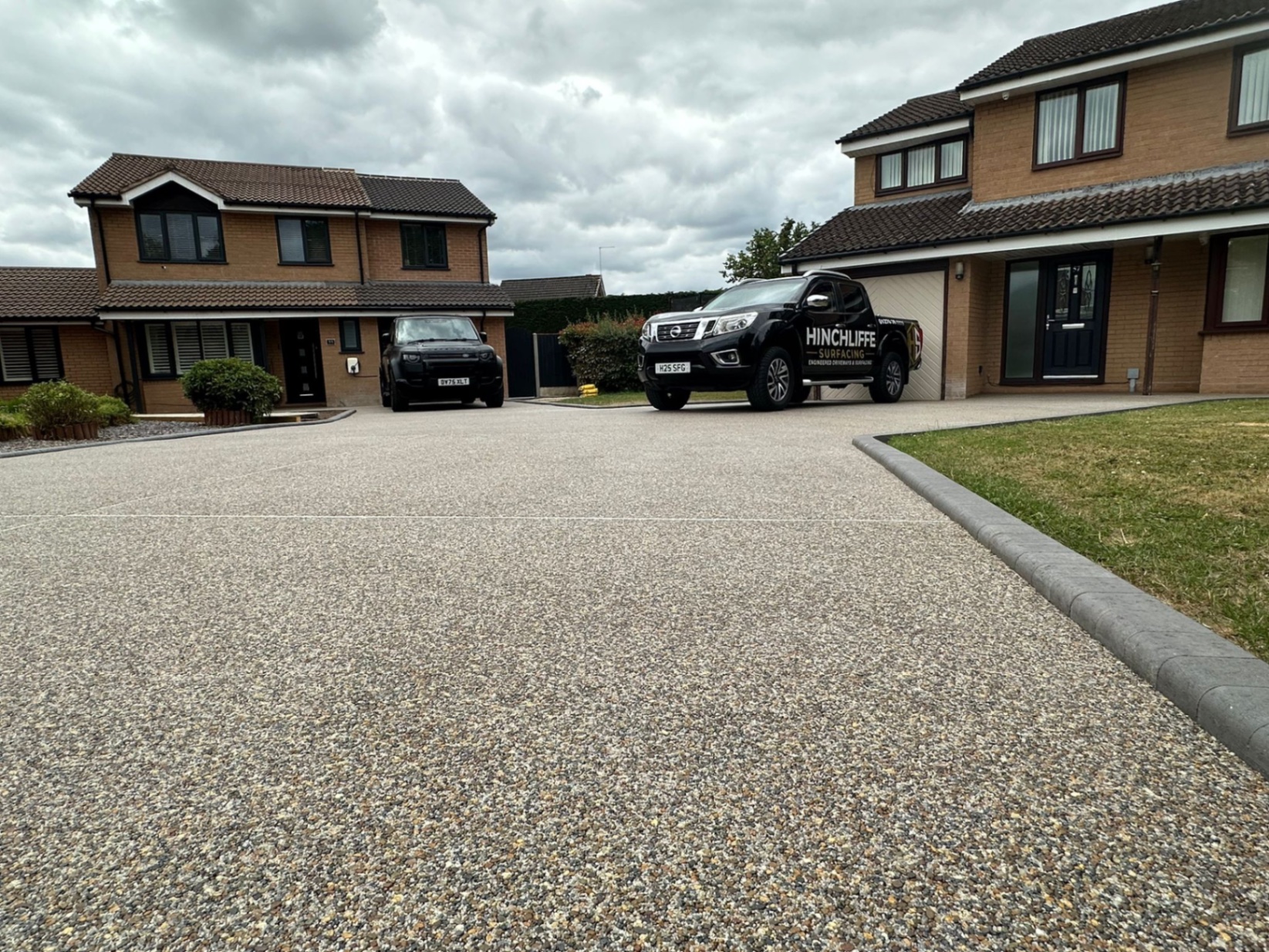
RESIN by Hinchliffe, our specialist crew for permeable, SUDS-aligned resin bound driveways.
Every resin by hinchliffe install is engineered using recognised pavement-construction principles and relevant BS 7533 guidance, survey, engineered sub-base, edge restraints and approved surface systems.
Compare permeable resin bound construction with non-permeable tarmac, concrete and standard block paving.
Our dedicated RESIN by Hinchliffe division installs permeable, SUDS-aligned resin bound driveways using Daltex resin-bound systems. Fully monolithic, no joints, no loose stones, no weeds. Water drains straight through the surface rather than pooling or running off.
Specialist surface options
Rubber stone surfacing
A rubber-and-stone surface option for paths and outdoor spaces. Build-up, drainage and suitability are determined at site assessment.
Coloured quartz surfacing
A decorative aggregate finish where colour and surface detail matter. The appropriate system and substrate are specified for the intended use.
Best for
- →Modern homes wanting a clean, seamless finish
- →Properties with existing drainage issues
- →Planning-sensitive front gardens, permeable construction can often avoid the need for planning permission where the complete system manages water within the property
Resin overlay or full resin system
Resin bound is a surfacing system, not a structure. What sits beneath it decides how it performs, so we separate the two routes clearly before specifying anything.
Resin overlay
For an existing base that assessment confirms is structurally sound, correctly drained and suitable to receive resin.
- 1Survey and assessment of the existing construction, levels and falls
- 2Preparation, cleaning and localised repair where required
- 3Priming as required by the manufacturer specification
- 4Resin bound surface installed to the specified depth
- 5Edge detailing and drainage interfaces completed
Where assessment shows the existing base is unsuitable, overlay is not offered and reconstruction is specified instead.
Full resin system
New construction or reconstruction, built from the formation upward.
- 1Excavation to formation
- 2Ground preparation and geotextile separation where required
- 3Structural sub-base appropriate to loading and ground conditions
- 4Base construction, permeable macadam resin-bound base where the full system is specified
- 5Drainage strategy, falls and permeability resolved within the construction
- 6Resin bound surface course installed to specification
Where permeable macadam is specified it forms the resin-bound base construction. Concrete or asphalt bases are not automatically specified beneath a full resin system.
The resin is the last 15mm of a much bigger decision
Resin bound is a wearing course. It is a mixture of graded aggregate and resin binder, trowelled out over something else and cured in place. It is strong in compression, seamless, permeable and it holds its appearance well. What it cannot do is bridge a base that moves, drain water that has nowhere to go, or restrain itself at an unsupported edge.
That is why two resin driveways at the same price per square metre can be completely different products. The visible surface is only one component of the pavement. Performance is decided by what the surface is sitting on, how water leaves the site, how the edges are held, and how much load the pavement is actually asked to carry.
Our starting position on every enquiry is therefore not which colour, but what is already there and what it can be relied upon to do. That assessment determines whether the correct answer is a resin overlay over retained construction, or a full resin bound system built from formation upwards.
What we assess before specifying resin
A resin specification that is written without seeing the site is a guess. These are the things we look at, and what each one changes.
- →What the current surface is, and whether it is bound (tarmac, concrete) or unbound (gravel, hardcore, worn block).
- →Its thickness and condition where this can be established, including any exploratory opening where the construction cannot be determined visually.
- →Whether it has been overlaid before, and how many times, because each overlay raises levels and hides the layer below.
- →Evidence of movement: stepped cracking, rocking slabs, depressions under wheel paths, kerb and edge displacement.
- →Contamination: oil, fuel, moss growth, standing algae, previously applied sealants or coatings that affect adhesion.
- →Where water currently goes in heavy rain, and where it stands afterwards.
- →Existing falls and whether they run away from, or towards, the building.
- →Threshold heights against doors, garages and airbricks, which set the maximum finished level.
- →Whether the subgrade is likely to accept infiltration, or whether a positive discharge route is needed.
- →Existing gullies, channels, downpipes, soakaways and any connection into them.
- →Edge condition: what currently restrains the pavement, and whether it is sound, missing or failing.
- →Interfaces with kerbs, paths, patios, planting, walls and adopted highway.
- →Utility covers, inspection chambers and their finished level relative to the new surface.
- →Existing joints and any movement joint that must be respected rather than surfaced over.
- →Real intended loading: everyday cars, a horsebox or trailer, delivery vehicles, a caravan, occasional heavy plant.
Hinchliffe full resin bound system construction
Where reconstruction is the right answer, we build the pavement, not just the finish. Layer types, thicknesses and materials are specified per project from the assessment; we do not publish one universal build-up because one universal build-up would be wrong on most sites.
- →Excavation to a formation that will actually support the pavement, taken to the depth the ground and the loading require rather than a fixed figure.
- →Formation assessed on site for softness, made ground, roots and water. Where formation is unsuitable, we treat it or build over it rather than proceeding on it.
- →Geotextile separation specified where the subgrade risks contaminating the granular layer, keeping the sub-base working as a structural layer instead of mixing into the ground beneath.
- →Open-graded granular construction where the design intent is infiltration, so water passes through the surface, through the base and into the ground or a designed discharge point.
- →Layer type and depth specified against loading, subgrade condition and the water strategy for that particular site.
- →Placed and compacted in controlled layers, to level and to the designed falls, rather than tipped and rolled in one pass.
- →A permeable macadam base course (permeable macadam) where the design requires a bound, permeable layer beneath the resin, giving the wearing course a stable, consistent substrate while retaining vertical drainage.
- →We do not treat conventional dense concrete or standard impermeable tarmac as our default new-build resin base, because both remove the permeability the system is chosen for.
- →Base course specification is a design decision on each project, not a fixed product applied everywhere.
- →Edge restraints designed to hold the pavement laterally: kerbs, haunched edgings, block or steel edge detail, or a retained sound structural edge where one exists.
- →Channels, gullies, threshold drains and level detailing set out before laying, not adapted afterwards.
- →Covers and chambers adjusted to finished level so the surface runs through cleanly.
- →Movement joints in the retained or underlying construction carried through the resin rather than buried, because a joint that is covered will still move.
- →UV-stable resin bound wearing course using Daltex resin-bound systems, mixed to the manufacturer's ratios with controlled batching.
- →Installed within the temperature, humidity and moisture conditions the system allows. Where conditions fall outside that window we stop; a resin surface laid in the wrong conditions cannot be corrected later.
- →Trowelled to a consistent thickness and finish by a resin crew, with aggregate, colour and batch control across the area.
- →Cured and protected before foot and vehicle use, with the timings for the specific system and the conditions on the day given to you in writing.
- →Handover with the system used, the construction beneath it, and the maintenance the surface needs recorded in your project documentation.
Exact depths, materials and layer arrangement are confirmed in your written specification following the site assessment.
Permeability, drainage and what SUDS actually means
A permeable resin bound surface allows water to pass vertically through it instead of running off. That is a real and useful property, and it is the reason resin bound is frequently chosen for front gardens.
It is not, on its own, SUDS compliance. A permeable surface only manages water if everything beneath and around it can accept, store and release that water. That means the base has to be open-graded rather than sealed, the subgrade has to accept infiltration or a discharge route has to be designed, levels and falls have to work, and the volume arriving in a storm has to be handled somewhere within the property rather than pushed onto the highway or a neighbour.
So the honest way to describe it is this: permeable construction is the surface component of a water-management strategy. Whether a scheme satisfies sustainable drainage and planning requirements depends on the complete design, the ground, the discharge route and the applicable local requirements, which we establish at assessment rather than assume.
Where infiltration is not viable, we say so and design a positive drainage solution instead. That is a better outcome than installing a permeable surface over ground that cannot take water and calling the job done.
Overlay or full system: how the decision is actually made
A resin overlay is not a discount version of reconstruction. It is a different specification with different preconditions. Overlay is only correct where the retained construction can be relied on to perform as part of the finished pavement.
Resin bound laid onto retained existing construction, typically sound bound tarmac or concrete, after preparation and detailing.
- →The retained base is structurally sound, bound and stable under load
- →There is no active movement, settlement or progressive cracking
- →Water drains away rather than standing on or within the construction
- →Threshold and level headroom allows the added build-up
- →Edges are restrained or can be properly restrained as part of the works
- →The base is clean enough for reliable adhesion after preparation
- →Existing joints can be respected and carried through, not concealed
Determined by: Determined by assessment of the retained construction, not by budget. Overlaying an unsound base transfers an existing defect into a new surface.
Pavement constructed from formation upwards: excavation, formation treatment, separation where specified, permeable granular construction, base course where specified, restraints, drainage and the resin wearing course.
- →The existing construction is unknown, unbound, thin or failing
- →There is movement, settlement or repeated patch repair
- →Water stands, tracks towards the building, or has nowhere to go
- →Levels or thresholds cannot accept additional build-up, so material must come out
- →Loading is increasing, for example a heavier vehicle, trailer or additional parking
- →The drainage strategy requires a permeable construction beneath the surface
Determined by: Determined by ground conditions, existing construction, drainage strategy, levels and intended loading.
If assessment shows overlay is viable, we will specify it. It costs you less and it is the correct engineering answer on a sound base. What we will not do is overlay a base we do not believe in.
Why resin systems fail
Resin bound is a well-proven surfacing system. Where installations do fail, the cause is usually beneath or around the resin rather than in the resin itself. Understanding the mechanisms is the most useful thing a client can take into a specification conversation.
A surface laid over construction that was already weak, thin, unbound or breaking up. The resin reflects what is beneath it; it cannot add structural capacity to a base that has none.
Settlement, differential movement or unrestrained joints below the wearing course transmit through a monolithic surface, typically appearing as cracking along the line of the movement.
A permeable surface over a sealed or saturated construction holds water in the pavement. Trapped water is the common factor behind softening, freeze-thaw damage and loss of bond.
Unrestrained or poorly haunched edges allow lateral movement and loss of support at the perimeter, where wheel loads are often at their most concentrated.
Oil, organic growth, dust or previously applied coatings compromise adhesion. Preparation is not cosmetic; it is what allows the system to bond as intended.
Resin systems have defined temperature, moisture and humidity limits. Laying outside them affects cure and long-term performance, and it cannot be corrected retrospectively.
A pavement designed for cars will not indefinitely carry delivery vehicles, plant or a loaded trailer turning on the same point. Real intended use has to be part of the specification.
None of this implies that other installations suffer these problems. It is a description of failure mechanisms, and the reason our sequence is Structure First. Surface Second.
How we reduce the risk on your project
Most of the cost difference between a considered installation and a cheap one is spent before the resin arrives.
Falls, discharge route, threshold levels and infiltration viability are established at assessment and written into the specification.
Excavation, formation treatment, separation and restraint appear in your documentation as scope, so you can see what is being built and what it costs.
Batching, ratios, thickness and conditions controlled on site by a resin crew, with work stopped rather than pushed through in unsuitable weather.
Our 5-Year Workmanship Guarantee covers our installation. Daltex product warranties are issued by the manufacturer under their own terms. They are two separate things and we describe them separately.
Maintenance requirements are issued at handover, and Surface Care visits can be scheduled so the surface is inspected and cleaned rather than neglected.
Where the money goes
A resin installation is not expensive because of the resin. It is priced by the work that makes the resin last.
Site visit, investigation of the existing construction, levels, drainage and loading before anything is specified.
A construction designed for your ground and your use, rather than a standard build-up applied everywhere.
Excavation, disposal, formation treatment, separation and restraint, the part you never see again.
Daltex resin-bound systems with UV-stable aggregate, specified granular materials and correct edge products.
A trained resin crew, controlled batching and conditions, and the discipline to stop when conditions are wrong.
Written specification, variation control, handover records, guarantee and a maintenance schedule.
We assess the existing construction, ground conditions, levels, drainage, access and intended loading before recommending the correct surface system.
Related reading
How every Hinchliffe pavement is assessed, specified and constructed.
What permeability actually changes, and what it does not.
What drives the figure, and what changes it on your site.
Excavation, formation, levels, drainage and restraint.
Planned inspection, cleaning and maintenance.
Approved systems, insurance, competency and guarantees.
The questions worth asking of any quotation, including ours.
Ground conditions and local detail across Cheshire.
RESIN by Hinchliffe, your questions.
Is resin bound built to BS 7533?
Our resin-bound systems are designed around site conditions, anticipated loading, drainage requirements and the complete Daltex manufacturer specification. Relevant pavement-engineering and BS 7533 principles are applied to the supporting construction where appropriate.
How long does a resin bound driveway last?
A properly installed resin bound driveway, on a structural sub-base, can provide decades of service. Longevity is decided by the sub-base and drainage below, not the resin itself. Our Daltex systems carry a manufacturer material warranty on top of our workmanship guarantee.
Is resin bound permeable and SUDS compliant?
Yes. Resin bound is fully permeable, water drains vertically through the surface into the sub-base rather than running off. Permeable construction can often avoid the need for planning permission for front-garden driveways, provided the complete system manages water within the property and satisfies applicable planning and drainage requirements. Final suitability depends on the complete construction, subgrade permeability, levels, discharge route and local site conditions, not the surface material alone.
Can resin bound be laid over my existing driveway?
Sometimes. If the existing surface is structurally sound, drains well and is properly bound (like sound tarmac or concrete), resin can be laid over it. We assess the base on-site, if it's failing, we excavate and rebuild rather than trap a future problem under a new surface.
Does resin bound get slippery, hot, or fade?
No. The aggregates give natural grip in the wet, the surface stays cool underfoot in summer, and Daltex UV-stable systems hold their colour rather than yellowing. Cheap non-UV resins do fade, we don't install them.
How long does installation take?
A typical residential resin bound driveway takes 5–10 working days end-to-end, including excavation, sub-base, drainage and the resin trowel-lay. The resin itself is usable within 4–6 hours of laying and takes full vehicle load after 24–48 hours.
What is the difference between a resin overlay and a full resin bound system?
An overlay retains the existing construction and adds a resin wearing course over it after preparation and detailing. A full system rebuilds the pavement from formation upwards: excavation, formation treatment, separation where specified, permeable granular construction, base course where specified, restraints, drainage and then the resin. Overlay is a specification decision based on whether the retained base can be relied on, not a cheaper alternative to reconstruction.
How do you decide whether my existing driveway can be overlaid?
We assess the existing construction, whether it is bound and structurally sound, evidence of movement or cracking, how water behaves on it, contamination, threshold and level headroom, and the condition of the edges. If the retained construction can perform as part of the finished pavement, overlay is viable. If it cannot, we specify reconstruction and explain why.
Does a permeable resin surface make my driveway SUDS compliant?
Not on its own. A permeable surface is one component of a water-management strategy. Whether a scheme satisfies sustainable drainage and planning requirements depends on the complete construction, whether the subgrade will accept infiltration, the levels and falls, the discharge route and the applicable local requirements. We establish that at assessment rather than assume it.
What construction depth will my resin driveway be?
It is specified per project. Depths and layer arrangement are determined by ground conditions, the existing construction, the drainage strategy, levels and thresholds, and the loading the pavement will actually carry. We publish the reasoning rather than a single universal figure, and the confirmed specification is issued in writing after the site assessment.
Can resin bound be installed at any time of year?
Resin systems have defined temperature, moisture and humidity limits for installation and cure. Work is programmed around suitable conditions and stopped where conditions fall outside the system's limits. Weather-sensitive installation dates are confirmed during the assessment and proposal process.
What maintenance does a resin bound driveway need?
Routine removal of organic matter and debris, keeping drainage points clear, prompt attention to oil or fuel spillage, and periodic cleaning. Requirements for your specific system are issued at handover, and Surface Care visits can be scheduled if you would rather it was inspected and maintained on a programme.
Resin-bound surfacing
- Assessment of the retained base
- Mechanical preparation
- Localised preparation where specified
- Primer where required
- Trims and interfaces
- UV-stable Daltex resin-bound wearing course
- Installation by a trained resin crew
- Applicable workmanship and product documentation
- Condition of the retained base
- Extent of localised preparation
- Measured area and edge detailing
Available only where the existing bound base is structurally stable, suitably drained and compatible with the proposed resin system. Structural repairs, extensive levelling, new drainage and failed-base reconstruction are additional.
- Excavation to the specified formation
- Disposal of arisings
- Formation assessment
- Geotextile separation where specified
- Engineered open-graded sub-base
- Drainage and edge restraints
- permeable macadam structural resin-bound base course
- UV-stable Daltex resin-bound wearing course
- Completion inspection
- Written guarantee documentation
- Excavation depth and spoil classification
- Access for plant and haulage
- Drainage strategy and edge details
- Selected aggregate blend
Recommended minimum resin project value: £5,000 plus VAT
The rates above cover the surfacing system itself. Everything below the surface, and everything site-specific, is measured and calculated separately in the Hinchliffe Project Builder™ process.
- Excavation, formation preparation and compaction
- Spoil removal, haulage and tip disposal
- Sub-base supply, laying and testing
- Drainage, soakaways, linear channels and SUDS provision
- Kerbs, edgings, retaining structures and level changes
- Service covers, utility alterations and manhole adjustment
- Restricted access, plant hire and site complexity allowances
- Mobilisation, welfare, traffic management and risk allowances
Guide prices are not quotations or contractual offers. Final pricing is issued only after site assessment, measured quantities and confirmation of the construction specification. Prices exclude VAT unless expressly stated otherwise. Unforeseen ground conditions, concealed services, contamination and client-requested changes are managed under the written contract and variation procedure.
Request a measured site assessmentResin Driveways by town
Ground conditions change from one Cheshire town to the next. Pick your area to see how we build there, what we typically find below the surface and what it usually costs.
Customer proof
"Dan came out to provide a quote for a driveway replacement including an extension to the existing driveway. We found Dan to be highly professional, very informative and the detailed quote enabled us to understand the cost breakdown precisely. It was easy to discuss options and benefits of each with Dan and his product knowledge was superb. From first point of contact we were highly impressed."
"We were really impressed with the project management, the team kept the neighbours informed throughout the job and everything ran smoothly from start to finish. A five-star service."
"Dan and the team were professional from start to finish. The workmanship was outstanding and the driveway has completely transformed our home. Highly recommend."